Proc360 is the Best Company to Import From China for SMEs
If you are looking for the best sites to import from China to Nigeria, you have probably already found the obvious names. Alibaba. AliExpress. Maybe 1688, if someone in a WhatsApp group mentioned it.
Finding the sourcing site is the easy part. What costs Nigerian importers money is everything that happens after the product is found: a supplier who will not take a Nigerian card, a factory that works only in Mandarin, a quote that covers the goods but not the clearing, and a shipping bill calculated on cartons full of air.
This guide covers both halves. First the sourcing sites and what each is genuinely good for. Then the part nobody writes about, which is what the goods actually cost by the time they reach your warehouse, and the four places that cost quietly inflates.
Importing from China is not a risky business. Standard Bank’s Africa Trade Barometer, which surveyed 2,218 firms across ten African markets, found the share of African businesses sourcing from China rose from 23% in 2023 to 34% in 2024. Roughly one in three now does it. The ones who lose money are not losing it on the website they chose.
Part 1: The sourcing sites, compared
These are the platforms Nigerian importers actually use. The differences matter more than most guides suggest, because they conflate four very different marketplaces.
Platform | Best for | Typical MOQ | The catch |
|---|---|---|---|
1688.com | Factory-direct wholesale at the lowest prices | 10 to 50 pieces | Mandarin only, RMB only, most suppliers do not ship abroad |
Alibaba.com | First bulk order where you want a safety net | Often 100 to 500+ | Prices carry an export markup. Still no payment route from Nigeria |
Taobao | Fashion, accessories, trend stock in small batches | Single units up | Chinese only, domestic delivery only |
AliExpress | Samples and testing whether a product sells | 1 unit | Retail pricing. Margin disappears at volume |
Made-in-China, Global Sources | Industrial goods, machinery, verified manufacturers | Varies, usually high | Narrower catalogue, slower to quote |
1688.com: the factory floor
1688 is Alibaba Group’s domestic wholesale marketplace, built for buyers inside China. Many sellers on Alibaba and AliExpress buy their own stock here, which is why prices typically run 20% to 50% below Alibaba for the same goods. It connects buyers directly with manufacturers and primary wholesalers, cutting out the export middleman.
What you give up is every convenience built for a foreign buyer. The interface is Chinese. Suppliers communicate through AliWangwang or WeChat in Mandarin. Payment clears in RMB through Alipay or a Chinese bank transfer. Most listed suppliers do not ship internationally.
None of that is unsolvable. Chrome’s auto-translate handles the interface. Image search finds the same product at a lower tier. A useful trick: copy the Chinese product title from an Alibaba listing and paste it into 1688 search, which returns far more results than an English query. What you still need is a way to pay in RMB and a way to get the goods out of China.
Alibaba.com: the export-facing option
English interface, Trade Assurance on qualifying orders, suppliers used to foreign buyers and international freight. For a first bulk order the premium often buys a worthwhile safety net.
One thing worth knowing before you rely on badges: the Gold Supplier label means the seller paid a membership fee. It does not mean they manufacture the goods, comply with export rules, or will match your sample. Verified Supplier indicates a third-party document audit, which is more meaningful but still not a quality guarantee. Trade Assurance holds funds in escrow, but refunds are denied if your specifications were vague, if no inspection was arranged, or if defects are only found after the goods reach Nigeria.
Taobao and AliExpress
Taobao is China’s consumer marketplace. Strong for fashion, accessories and trend-led stock in small batches, and useful for finding unique items through image search. Chinese only, domestic delivery only.
AliExpress is retail. Order a sample here before committing to a carton. It is a poor place to buy anything you intend to resell, because you pay retail and then pay express shipping on top of it.
Part 2: What the goods actually cost
Here is where most importers get caught. The factory price is often less than half of what the goods cost by the time they are in your warehouse.
Your real landed cost is the product price converted from RMB, plus domestic Chinese freight to the consolidator, plus international freight, plus marine insurance, plus Nigerian import duty of 0% to 35% on the CIF value, plus 7.5% VAT, plus the 7% ETLS surcharge, plus the CISS fee, plus SONCAP or NAFDAC fees where they apply, plus clearing agent fees, plus terminal handling, plus inland trucking, plus demurrage if anything goes wrong.
Demurrage at Apapa can exceed US$100 per container per day. It starts a few days after the vessel arrives, and it is the fastest way a profitable order becomes a loss.
A working rule among importers who last: price at 2.5 to 3 times your landed cost, not your product cost. A 1.5x margin gets eaten alive by naira volatility, customer returns and marketing costs.
One more thing about exchange rates The rate Google shows is not the rate you will transact at. Your money goes from naira to dollars to RMB, and each leg has a spread. Compare your bank’s Form M desk, your fintech, and your sourcing platform on the day you convert. A 3% to 5% divergence between them is normal, and on a large order that difference is the whole margin. |
Part 3: The four places your cost quietly inflates
These are the costs that do not appear as a line item. You never get charged for them directly. You just notice the total is higher than you budgeted and assume that is normal.
1. You pay to ship air
You order ten items from different suppliers. They arrive at a warehouse in China. If nobody merges the cartons, removes the fillers and strips the unnecessary packaging, everything ships exactly as it arrived.
You are charged by weight or volume. So you are not paying for ten compact items. You are paying for ten cartons, the nylon, the foam and the empty space between them. This is invisible because you were told your goods would be shipped, not how they would be packed. Ask any provider directly whether they consolidate and repack, and whether that costs extra.
2. The quote was an estimate, not a figure
You get a cost before shipping and it looks fine. Then the goods arrive and there are additional charges before anything is released. At that point the container is at the port, you cannot cancel, and you pay whatever you are told.
The question to ask before you commit is whether the shipping quote includes customs clearance or excludes it. Those are very different numbers, and a quote that excludes clearing will always look cheaper than one that includes it.
3. Nobody checked the goods
In most arrangements, no one opens your cartons before they ship. You find out what is in them when they reach Lagos, which is thousands of miles too late to do anything about it.
Third-party pre-shipment inspection in China runs roughly US$149 to US$320 per man-day from firms like TESTCOO, TradeAider, V-Trust, QIMA and SGS. Set that against the arithmetic: a 20% defect rate on a US$30,000 order is a US$6,000 loss, against roughly US$300 of inspection. Most Nigerian importers either do not know pre-shipment inspection exists or assume it is a service for multinationals. It is not.
Your supplier checking their own goods is not an inspection. It is the supplier’s opinion of the supplier’s work.
4. You sourced blind
Thousands of suppliers, prices that vary wildly for the same item, quality you cannot assess from photographs, and a language gap in the middle. So you pick the cheaper supplier and receive worse goods, or you overpay because you never saw the real market price, or you order the wrong specification because something was lost in translation.
A workable verification routine before you pay anyone: cross-check the business licence number on Tianyancha or Qichacha, confirm the company name on the storefront matches the bank account name, ask for a live video walk of the factory, and reverse-image search the product photos to spot stolen catalogues.
And the single biggest loss pattern in this market: a supplier who asks you to pay off-platform, to a personal account, to WeChat Pay or by Western Union, to avoid fees. That voids every protection you had. If the bank details on the final invoice differ from earlier correspondence, stop and verify by a channel you already trust.
Part 4: Three ways to actually get the goods home
Every sourcing site above ends at the same wall. The supplier is in China, your money is in naira, and your warehouse is in Lagos or Aba or Kano. There are three ways across, and the choice affects your profit more than the marketplace did.
Route 1: A procurement agent
You send product links to an agent. They buy, receive and ship. It is the oldest route and still the most common.
It works until it does not. You rarely see the supplier invoice, so you cannot separate what the goods cost from what you were charged. Pricing is quoted per job rather than published. The agent holds the supplier relationship, so if they stop responding you lose the supplier too. And a recurring pattern in this market is the local agent who collects an upfront fee and goes quiet.
Importers who have been through it rarely describe outright theft. They describe a slow loss of visibility until they no longer knew what they were paying for.
Route 2: A freight forwarder
Companies like GIG Logistics give you a receiving address in China and move your goods home, publishing rates of around $10.50 per kg for regular air cargo and $550 per CBM for general sea freight with clearance included.
That is a clean solution to half the problem. Shipping is handled and priced openly. Payment is not. You still have to pay a supplier who will not accept your card, which is how most importers end up back with an agent anyway, paying two parties for one job.
Route 3: Do it yourself on a platform
The third route is to run the whole thing yourself through one account, where you stay the buyer rather than handing the job to someone else.
Proc360, registered under CheckIt Limited with warehouses in China and Nigeria, is built for this. You find verified suppliers on 1688, Alibaba, Pinduoduo and elsewhere from inside the app. You fund a wallet and pay your Chinese suppliers directly, with no RMB account needed. You request a quality check before your goods leave China and get a report showing what was checked and the exact quantity received. You combine orders from different suppliers into one shipment and save on shipping. You track the shipment from the warehouse to your door, and your goods clear customs without you chasing anyone.
The published rates: air freight at $11.40 per kg for regular items and $12.80 for special items, sea freight at $390 per CBM, quality checks at $0.50 per kg, consolidation free, and 30 days of free storage in your own China storage unit. Shipping includes customs clearance, which is why comparing it against a quote that excludes clearing is not comparing the same thing.
If you would rather not place the order yourself, Buy For Me handles the purchase on your behalf at 6% on product links, 8% on pictures and 10% on descriptions, with inspection by default and a refund policy you can hold someone to. Most people start there and move to self-serve once they have done it once.
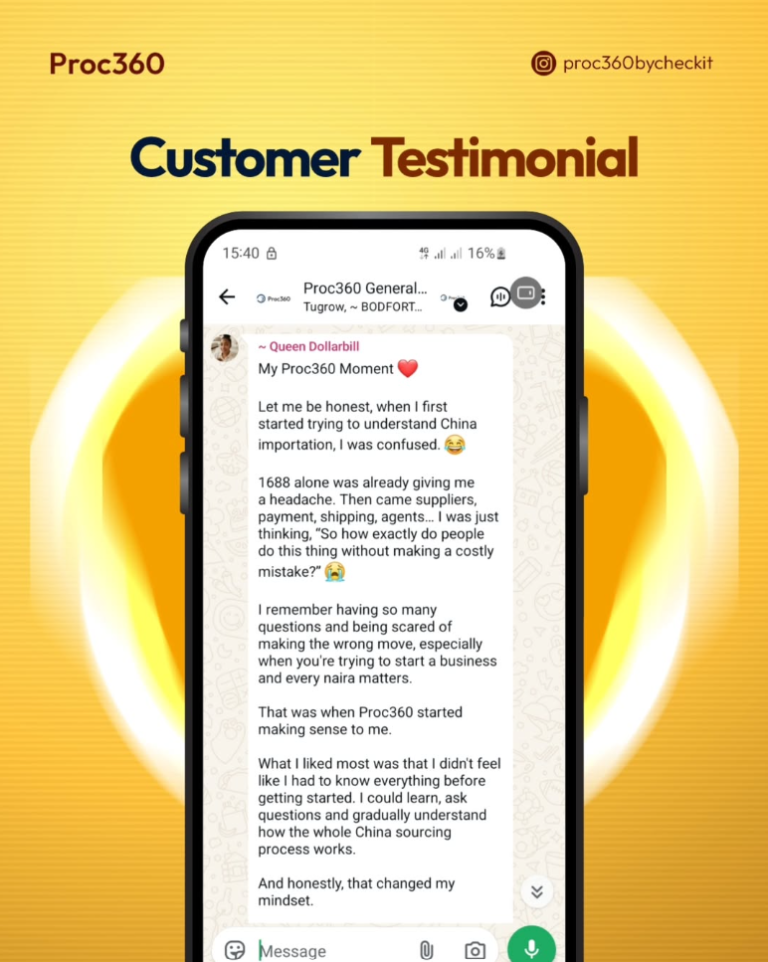
More than 10,000 businesses have signed up and over 2,000 transactions have crossed the platform, representing more than $750,000 in procurement value. That figure is the value of goods users bought, not platform revenue.
The proof

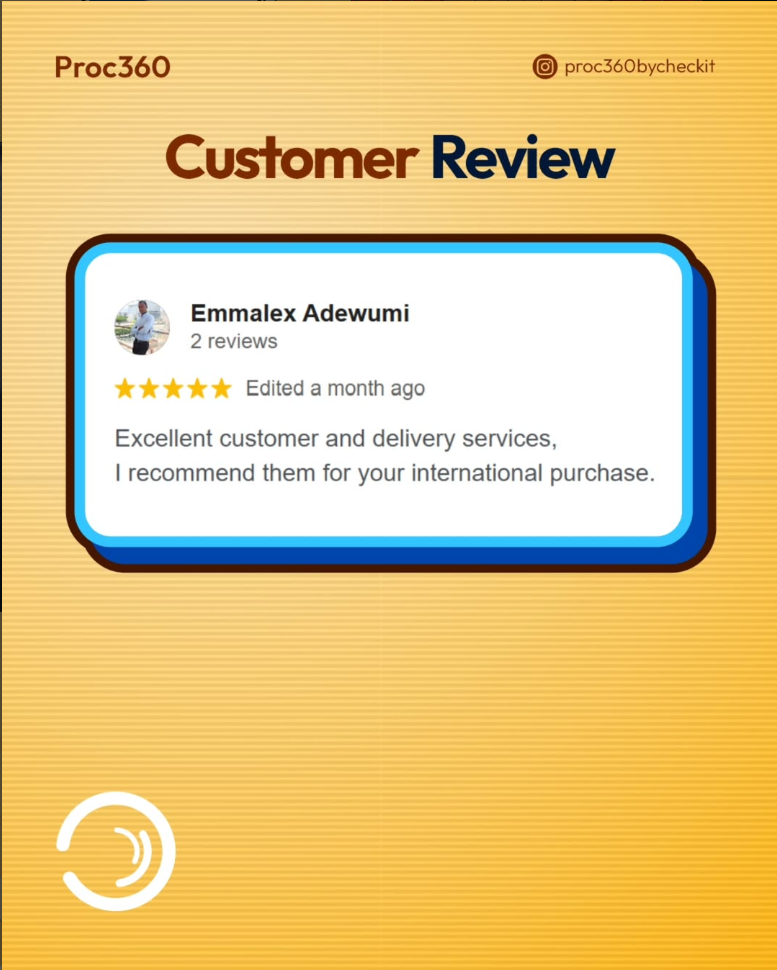
Over 12,000 businesses have signed up to Proc360 and more than 3,000 transactions have crossed the platform, representing over $750,000 in procurement value. That figure is the value of goods users bought, not platform revenue.
Side by side
Agent | Freight forwarder | Doing it yourself on a platform | |
|---|---|---|---|
You see the real supplier price | Rarely | Yes | Yes |
Fees published upfront | Rarely | Yes | Yes |
Pay suppliers in naira or cedis | Yes | No | Yes |
Handles RMB and Mandarin | Yes | No | Yes |
Storage and consolidation | Varies | Sometimes | Yes, 30 days free |
Inspection before shipping | Varies | Rarely | Yes, on request |
You keep the supplier relationship | No | Yes | Yes |
Clearing included in the quote | Varies | Varies | Yes |
You track it yourself | No, you call them | Usually | Yes |
Part 5: Which approach fits your size
If you are importing for the first time, or testing with under 50kg, order a sample on AliExpress to confirm quality, then move the real order to 1688 so your first proper shipment is not at retail prices. Air freight suits this size, because the per-kg cost hurts less than five weeks of your capital sitting on a ship.
If you are restocking regularly, somewhere between 100kg and a few CBM, consolidation becomes the thing that matters most. Combining four small orders into one shipment removes three sets of handling, documentation and trucking costs. Sea freight starts to earn its wait at this volume, and with 1 CBM calculated as length times width times height in centimetres divided by 1,000,000, the difference between a well-packed and a badly-packed shipment is money you keep.
If you are moving containers, your concerns shift to quality control and clearing. The break-even between LCL and a full container sits around 15 CBM. A 20-foot container holds about 33 CBM with roughly 25 to 28 usable; a 40-foot holds about 67 with 54 to 58 usable. At this level inspection before goods leave China is not optional, because a container of the wrong specification is not a problem you can fix after it lands at Apapa.
Part 6: The timing nobody plans for
Two dates shape the importing year and most people meet them late.
Chinese New Year is the bigger one. The official holiday runs seven to nine days, but the real factory disruption window is six to eight weeks, roughly three weeks of pre-holiday rush and three weeks of ramping back up, with a large share of factory workers not returning to the same employer. Expect lead times to stretch by two to six weeks around it.
The second is your own selling peak. For Christmas and Detty December, sea freight orders need to ship by mid-September and air by early November, with production locked in around August. For September school resumption, sea orders go in June or July. Working backwards from the selling date rather than forwards from the order date is the whole skill.
Mistakes that cost Nigerian importers the most
- Budgeting the product cost and not the clearing cost
- Using Google’s exchange rate for landed-cost maths
- Skipping the sample, then skipping the inspection
- Paying off-platform to a personal account that does not match the company name
- Accepting a DDP quote from a supplier who misdeclares the value, leaving you exposed to seizure or back-duty
- Not checking SONCAP or NAFDAC requirements before shipping a regulated product
- Importing something on the prohibition list, where a seizure is a total loss rather than a delay
- Shipping electronics without confirming 220V compatibility and English labelling
Frequently asked questions
What is the best site to import from China to Nigeria for a small business? 1688 gives the best prices, often 20% to 50% below Alibaba, but it needs a payment and shipping route on top because suppliers will not take Nigerian cards or ship to Nigeria. For a small business the practical answer is 1688 for sourcing plus a platform that handles RMB payment and consolidates your shipping.
Can I import from China without travelling there? Yes. Almost all Nigerian importers now source entirely online. You find products on 1688 or Alibaba, pay from a wallet in naira, have the goods received and inspected at a warehouse in China, and ship them home. Travelling only pays off when you are auditing factories at container volume.
How much does it cost to ship from China to Nigeria? Air freight generally runs between $10.50 and $12.80 per kg depending on the item, and sea freight between $390 and $550 per CBM. Air takes five to ten days, sea takes 36 days or more to Lagos. Always confirm whether the quote includes customs clearance before comparing.
How do I pay a Chinese supplier from Nigeria? Most 1688 and Taobao suppliers accept only Alipay or a domestic Chinese bank transfer, neither available to a Nigerian account. The practical routes are a wallet that lets you pay suppliers in RMB without an RMB account, or a formal Form M transfer through a CBN-authorised dealer bank for larger declared shipments.
Is 1688 cheaper than Alibaba? Usually, often by 20% to 50%, because 1688 sellers are frequently the factories supplying Alibaba’s trading companies. The saving normally survives the cost of a payment and sourcing service, which is why most importers migrate to 1688 once they are confident in a supplier.
Do I really need a pre-shipment inspection? On anything above a trial order, yes. Independent inspection in China starts around US$149 and the alternative is discovering a defect rate after the goods have cleared Nigerian customs, when you have no recourse against anyone. It is the cheapest insurance in the whole process.
Before you place the order
The importers who stay profitable are not the ones who found a secret website. They are the ones who know their landed cost before they pay, who consolidate instead of shipping piecemeal, who check the goods before they leave China, and who work backwards from the date they need stock on the shelf.
Pick your sourcing site for price. Pick everything after it for visibility.